House Clearance After Death: A Compassionate Step-by-Step Checklist
17 June 2026 · 16 min read · Lancashire House Clearance
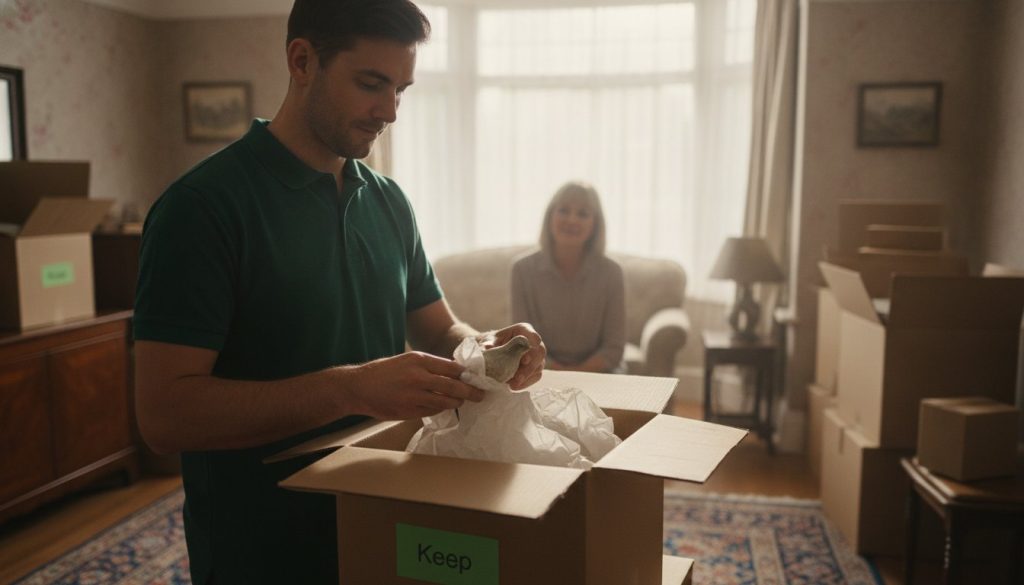
You stand in the hallway of a house that has been a sanctuary for decades, now tasked with deciding what stays and what goes. It’s a moment where the emotional weight of loss meets the cold reality of logistics. Most people find that the hardest part isn’t just the physical work, but the pressure of valuing items for house clearance correctly to satisfy HMRC while honouring a loved one’s legacy. It’s completely natural to feel exhausted before you’ve even picked up the first box.
We understand that you want to do right by your family and the environment, yet the complexity of probate and the fear of discarding something precious can feel paralysing. This guide offers a compassionate, structured approach to help you navigate this transition in Lancashire. You’ll learn how to identify sentimental treasures, meet your legal obligations, and ensure that unwanted goods are disposed of ethically. We’ve broken the process down into manageable steps so you can focus on what truly matters.
Key Takeaways
- Secure the property and notify insurance providers immediately to protect the estate whilst keys are being organised.
- Manage emotional exhaustion by using a structured room-by-room traffic light system to categorise belongings for keeping, donating, or recycling.
- Discover how valuing items for house clearance professionally can identify high-value assets to offset your total service costs through auction credits.
- Protect yourself from legal liability by verifying a team’s Waste Carrier Licence and prioritising a documented zero-to-landfill commitment.
- Maximise the property’s market value for sale or handover with a final sweep of overlooked areas like lofts and a thorough deep clean.
Table of Contents
- Phase 1: Immediate Actions and Legal Essentials
- Phase 2: Sorting Belongings with Empathy and Care
- Phase 3: Valuing Items for House Clearance and Auction Offsets
- Phase 4: The Physical Clearance and Zero-to-Landfill Policy
- Phase 5: Preparing the Property for Sale or Handover
Phase 1: Immediate Actions and Legal Essentials
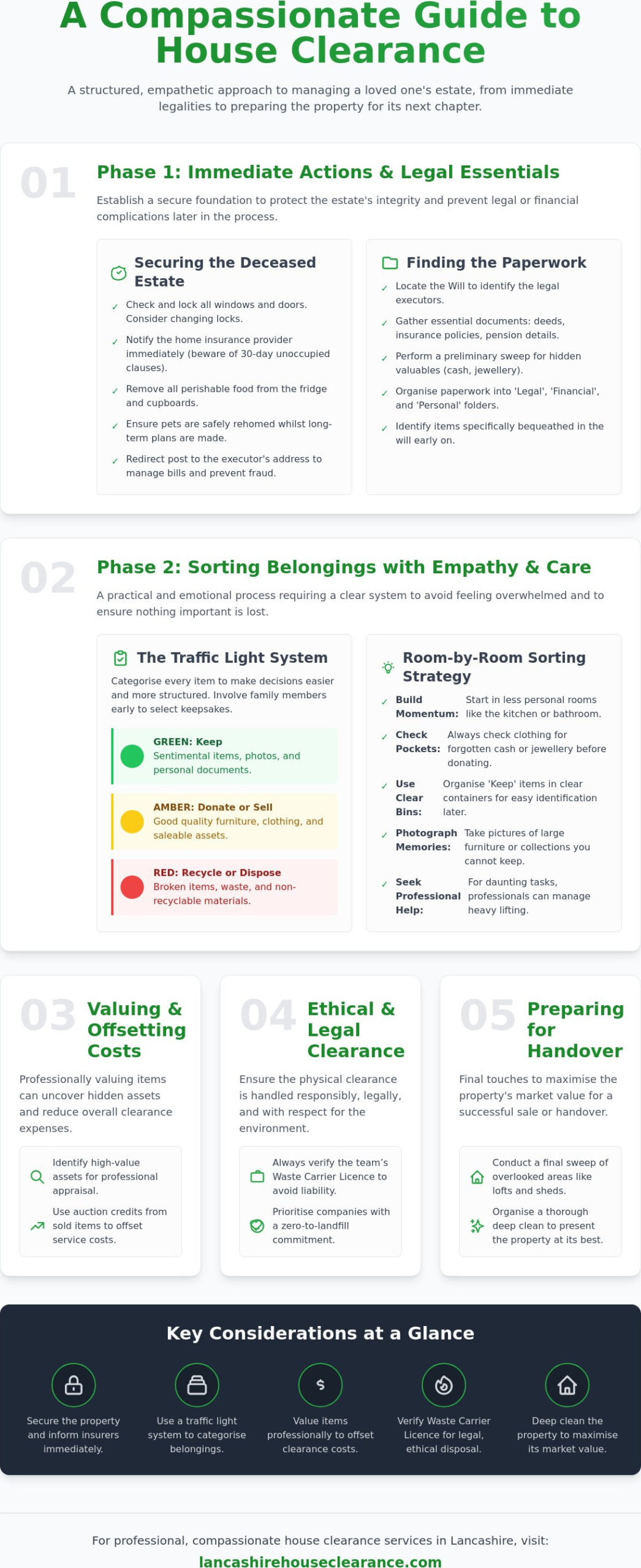
Before you begin the physical labour of clearing a home, you must first establish a secure foundation. This initial phase is less about moving furniture and more about protecting the estate’s integrity. It’s a time for quiet assessment and administrative diligence. Taking these steps now prevents significant legal and financial complications later in the process.
Securing the Deceased Estate
Securing the property is your absolute priority. You should check every window and door to ensure the home is locked. If keys are missing or if you suspect several copies are in circulation, it’s wise to have the locks changed by a professional locksmith. This isn’t about lack of trust; it’s about fulfilling your duty of care to the estate. You must also notify the insurance provider immediately. Many UK home insurance policies have strict unoccupied property clauses that may trigger after 30 days of the house being empty. Failing to inform them could void the policy if a pipe bursts or a break-in occurs.
- Remove perishables: Clear out the fridge and cupboards to prevent pests and unpleasant odours.
- Care for pets: Ensure any animals are rehomed amongst family or friends whilst the long-term situation is resolved.
- Redirect the post: Set up a redirection service to the executor’s address. This helps manage incoming bills and reduces the risk of identity theft.
Finding the Paperwork
Locating the Will is the most vital administrative task. This document identifies the named executors who have the legal authority to handle the estate. Once you’ve identified the executors, gather all essential paperwork into a central, organised folder. This should include life insurance policies, pension details, and property deeds. You’ll need these to apply for probate and to understand the full scope of the assets.
Perform a preliminary sweep of the property before any outsiders or clearance teams enter. People often hide cash in coat pockets, envelopes tucked into books, or even under loose floorboards. This initial search is the first stage of valuing items for house clearance, as it allows you to identify what needs to be set aside for professional appraisal. You might ask yourself what is an estate sale and how it applies here; essentially, it is a structured way to liquidate personal assets, which is only possible once the legal paperwork is fully organised. Categorise your findings into Legal, Financial, and Personal folders to streamline your communication with solicitors and valuers. Identifying specifically bequeathed items early ensures that sentimental wishes are honoured before the general clearance begins. Maintaining this level of organisation ensures precision when valuing items for house clearance later on.
Phase 2: Sorting Belongings with Empathy and Care
Sorting through a lifetime of possessions is a profound emotional challenge. It requires a delicate balance of practical decision-making and personal space to grieve. By establishing a clear method, you can manage the volume of items without becoming overwhelmed by the scale of the task. Taking your time here ensures that nothing of value, either sentimental or financial, is accidentally discarded.
We recommend a Traffic Light system to categorise every object in the home. Mark items as Green (Keep), Amber (Donate or Sell), or Red (Recycle or Dispose). This structured approach is the first practical step in valuing items for house clearance, as it allows you to separate potential assets from general household waste. Invite family members to choose their keepsakes early in the process. This prevents conflict later on and ensures that everyone feels involved in the legacy of the home.
The Room-by-Room Sorting Strategy
Momentum is vital. Start in the kitchen or bathroom. These rooms usually contain fewer deeply personal mementoes than a bedroom or study, making it easier to build confidence in your decision-making. Check the pockets of every coat and pair of trousers before deciding to donate or recycle them. It’s common to find forgotten cash, receipts, or small pieces of jewellery tucked away in linings. Use clear plastic bins for your Keep pile. Seeing the contents at a glance reduces the stress of searching through stacked cardboard boxes when you’re looking for a specific document or photograph later. If the physical volume of furniture feels too daunting, our domestic house clearance services can provide the professional support needed to manage the heavy lifting.
Managing Sentimental Items
Not everything can be kept, but everything can be remembered. Photographing large pieces of furniture or collections that you don’t have space for is a gentle way to preserve the memory without the physical clutter. Set a firm limit on the number of Memory Boxes you will keep for items with high sentimental but low market value. This prevents your own home from becoming overcrowded. For those who need more emotional support during this transition, you can read our compassionate guide to bereavement clearance in Chorley. Setting these boundaries early helps you stay focused on the logistical goal whilst still honouring your loved one’s life. This clarity is essential when you move on to the more technical stage of valuing items for house clearance for probate or sale.
Phase 3: Valuing Items for House Clearance and Auction Offsets
Once the emotional sorting is complete, the focus shifts to the financial assessment of the estate. This stage is critical for executors who have a legal duty to the beneficiaries. Accurately valuing items for house clearance ensures that no significant assets are overlooked and that the estate is settled fairly. It also provides a practical way to manage the costs of the clearance itself through professional appraisal and resale.
For estates where the total value might approach tax thresholds, valuations must be HMRC-compliant. This involves providing realistic open-market values rather than sentimental estimates. High-value items such as jewellery, fine art, or rare antiques require professional assessment to ensure the Inheritance Tax return is accurate. This protects the executor from potential penalties for undervaluation whilst ensuring the estate doesn’t pay more tax than necessary. Executors managing this process can find detailed guidance in our probate house clearance Lancashire guide for executors, which covers HMRC-compliant written valuations and cost offset strategies in full. Identifying these items early allows for a smoother transition to the physical clearance phase.
How Auction Offsets Work
Many families are surprised to learn that the contents of a home can actually pay for the clearance service. This is known as an auction offset. In this model, the labour and disposal costs are calculated first. Then, the estimated resale value of saleable goods is deducted from that total. It’s a transparent alternative to traditional “cash for junk” schemes where a dealer might offer a small lump sum for everything, often leaving the family out of pocket. You can learn more about house clearance costs and offsets in Wigan to see how this pricing structure works in practice. By using professional auction consignment through a trusted local partner, you ensure that items reach the widest possible market of buyers.
Identifying Saleable vs. Recyclable Items
Not everything that looks old is an antique, and not everything modern is worthless. Currently, mid-century teak furniture, vintage hi-fi equipment, and specific collectables like vinyl records or retro toys often hold surprising value. Conversely, large Victorian wardrobes or heavy dining sets may have low current auction demand in Lancashire because they’re difficult to transport or don’t fit modern interior trends. Professional valuing items for house clearance distinguishes between these categories. This ensures that items with genuine market appeal are sent to auction whilst others are donated or recycled. Ultimately, a professional valuation protects the estate’s beneficiaries from losing financial value by ensuring every item is placed in the most appropriate channel.
Phase 4: The Physical Clearance and Zero-to-Landfill Policy
The transition from planning to the physical removal of belongings is often the most exhausting stage of the process. It requires significant manual labour and a clear understanding of UK waste regulations. When you hire a professional team, your first step must be to verify their Waste Carrier Licence. This isn’t just a formality. If your items are fly-tipped by an unlicensed operator, you remain legally responsible and could face substantial fines. A reputable firm will always provide a waste transfer note, giving you peace of mind that the estate’s contents are being handled lawfully.
Choosing a company with a strict zero-to-landfill commitment is an act of stewardship. It ensures that the process of valuing items for house clearance extends beyond financial gain to include environmental ethics. By segregating materials into specific streams like wood, metal, textiles, and E-waste, we can ensure that as much as 80% or more of the house contents are diverted from landfill. This methodical approach reflects the care taken during the earlier stage of valuing items for house clearance, ensuring that every object is treated with respect whilst honouring the history of the items themselves.
Why Zero-to-Landfill Matters
Irresponsible waste management carries a heavy environmental cost. Landfill sites are increasingly scarce, and the standard rate for landfill tax in the UK has risen to £130.75 per tonne as of April 2026. Beyond the financial implications, recycling and reuse preserve the legacy of a loved one’s possessions. Giving a second life to a kitchen table or a set of curtains through local Lancashire-based charities supports the community directly. For a deeper look at our ethical standards, check our guide to zero to landfill house clearance.
Handling Difficult Items
Certain household objects require specialised handling to meet legal standards. White goods and electronics fall under WEEE (Waste Electrical and Electronic Equipment) regulations and cannot simply be thrown into a general skip. Similarly, bulky items like beds require specific routes. We can assist with organising ethical mattress disposal in Chorley to ensure they are stripped for parts rather than buried. When moving bulky furniture, we use protective equipment to prevent damage to property walls and doorways. If you need assistance with the heavy lifting, our team offers professional bulky item clearance to help you reclaim your space safely.
Phase 5: Preparing the Property for Sale or Handover
The echoes of a busy household have faded, leaving behind a blank canvas. Whilst the physical removal of furniture is a significant milestone, the final details of property preparation are what ensure a smooth transition for the next occupants. This stage is about transforming the space from a lived-in home into a marketable asset or a clean slate for a new tenant. Taking these final steps protects the estate from ongoing costs and presents the building in its best possible light.
By this point, the meticulous process of valuing items for house clearance has concluded. You have successfully navigated the emotional and logistical hurdles of sorting a lifetime of belongings. Now, the focus shifts to the structure itself. A thorough final sweep is essential. Check the loft, the cellar, and the garden shed one last time. It’s surprisingly common to find overlooked items tucked away in eaves or behind rafters. Ensuring these spaces are completely bare is a requirement for most property sales and prevents delays during the completion phase.
The Final Property Check
Once the rooms are empty, perform a detailed inspection of the floors and walls. Heavy furniture often hides issues that were previously invisible, such as damp patches, frayed carpets, or structural cracks. Identifying these now allows you to address them before the property goes on the market. We recommend a deep clean of the entire premises. Wiping out cupboards, cleaning windows, and sweeping all hard floors significantly improves the saleability of the home. It signals to potential buyers that the property has been well-maintained and cared for. Verify that every item you identified during the stage of valuing items for house clearance as a “Keep” or “Sell” item has been safely removed from the premises.
Finalising Utility Accounts
Managing the administrative handover is just as important as the physical one. You must record final meter readings for water, gas, and electricity on the day you officially relinquish control of the property. Take photographs of the meters as evidence to prevent disputes with providers later. Contact each utility company to provide these readings and the date of the property transfer. This ensures that the estate is not billed for energy used by the new owners or tenants. Don’t forget to cancel ongoing service contracts, including broadband, satellite television, and garden maintenance.
Finally, gather all sets of keys and any relevant property documentation, such as boiler service records or electrical safety certificates. Handing these over to the estate agent or the new owners marks the formal conclusion of your journey. For a comprehensive summary of these final steps, you can refer to our parent guide on bereavement house clearance in Lancashire. Completing this checklist allows you to close this chapter with the confidence that you have fulfilled your duties with integrity and care.
Taking the Next Step with Confidence
Navigating a house clearance after a loss is a significant undertaking that requires a balance of logistical precision and emotional space. By following a structured approach, you ensure that legal duties are met whilst the sentimental history of the home is respected. From the initial securing of the property to the final meter readings, every step you take is an act of stewardship for your loved one’s legacy. Accuracy in valuing items for house clearance is particularly vital, as it protects the interests of beneficiaries and provides a clear path through the probate process.
Lancashire House Clearance is a family-run business with over 30 years of experience supporting families across Lancashire. We understand the weight of these transitions and offer a service grounded in trust and transparency. Our team operates with a strict zero-to-landfill commitment and a full auction valuation offset service to help reduce your final invoice. When you are ready to begin, we invite you to Request a Compassionate House Clearance Quote from Lancashire House Clearance. You’ve managed the most difficult part by starting this process; let us handle the heavy lifting for you.
Frequently Asked Questions
How long does a house clearance after death usually take?
Most standard property clearances in Lancashire are completed within one to two days. Larger homes or estates with significant outdoor buildings may require more time. The initial sorting process performed by the family often takes several weeks, but once our team arrives, we work efficiently to ensure the property is ready for its next chapter without unnecessary delays.
Do I need to be present during the clearance day in Lancashire?
You don’t need to be present on the day if you have already categorised the items. Many clients find the physical removal of a loved one’s possessions emotionally difficult and prefer to leave a key with us or an estate agent. We maintain constant communication and provide a thorough report once the property is completely empty and secured.
Who is legally responsible for paying for the house clearance after a death?
The estate of the deceased person is responsible for all clearance costs. This is categorised as an administration expense. The executor usually settles the invoice from the estate’s funds before the remaining assets are distributed to beneficiaries. If the estate lacks liquid cash, the executor may pay the cost and reclaim it once the property is sold.
Can I sell items from the house before probate is granted?
You can sell items before probate is granted if the executor authorises the sale to cover essential estate expenses. It’s vital to maintain precise records for valuing items for house clearance to satisfy HMRC requirements later. You must also ensure that the items being sold have not been specifically bequeathed to a beneficiary in the Will to avoid legal conflict.
What happens to items that cannot be sold or donated during the clearance?
Items unsuitable for resale or charity are transported to a licensed waste transfer station for recycling. We separate materials like wood, metal, and textiles to ensure they are processed according to UK environmental regulations. This methodical approach to valuing items for house clearance ensures that even non-saleable goods are diverted from landfill whenever possible, fulfilling our ethical commitment.
How much does a professional bereavement clearance in Lancashire cost?
The total cost depends on the size of the property and the volume of belongings to be cleared. Factors such as the presence of bulky items or the distance to specialised recycling centres also influence the price. We provide a bespoke quote after a physical or video assessment. This allows us to identify any auction offsets that could significantly reduce the final invoice.
Is it better to hire a skip or a clearance company for a deceased estate?
A clearance company is almost always a better choice than a skip for a deceased estate. Skips require you to perform all the heavy lifting and don’t offer any recycling or auction offset benefits. A professional team provides the labour, identifies items of value, and ensures that sensitive documents are handled correctly, which a skip service cannot provide.
Can you clear a house if there is heavy hoarding involved?
We have significant experience in clearing properties where heavy hoarding is present. These cases require a patient, methodical approach to ensure that important legal documents or hidden treasures are not lost amongst the volume of items. We work sensitively to return the home to a safe, clean condition, making it ready for sale or renovation whilst respecting the family’s privacy.
Ready for a free, no-obligation quote?
Call or message us today — tell us the postcode and what needs clearing, and we’ll do the rest.