What Happens to Items After a House Clearance? An Ethical Guide
13 June 2026 · 16 min read · Lancashire House Clearance
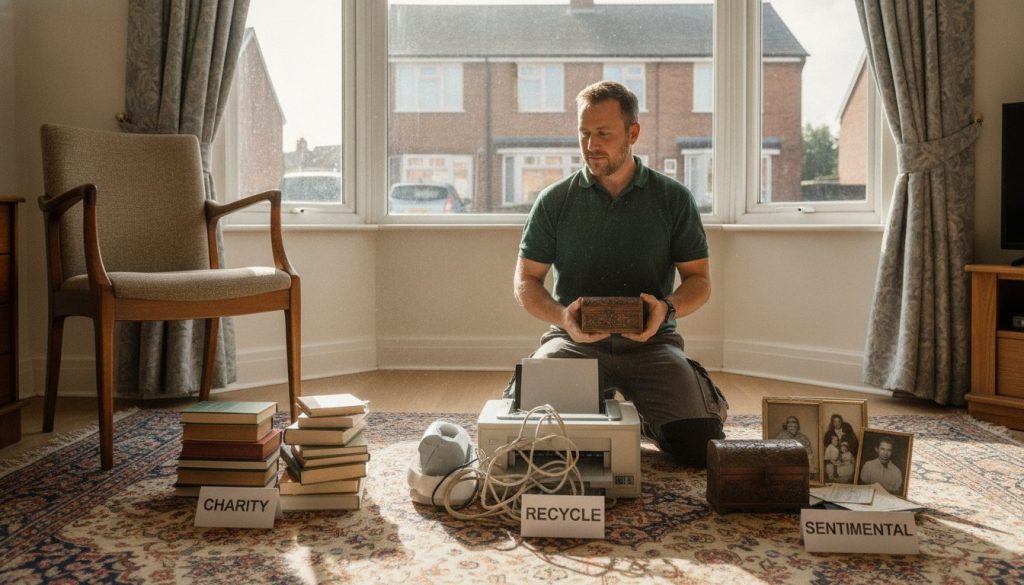
Did you know that councils in England dealt with 1.26 million fly-tipping incidents in the 2024/2025 period? This staggering figure often fuels the anxiety many people feel when they wonder exactly what happens to items after house clearance once the van leaves the driveway. It’s difficult to hand over a lifetime of possessions, especially when you’re already navigating the emotional weight of a deceased estate. You want to be certain that your items won’t be part of the estimated 20% of waste that is managed illegally, but rather handled with the dignity they deserve.
We believe that a professional clearance should be a transparent and compassionate process. This guide will show you how we turn a daunting task into an ethical success story, ensuring that your belongings find new homes or are recycled according to the latest 2026 WEEE regulations. You’ll discover how we prioritise charitable donations and use professional auction offsets to provide financial clarity, especially as landfill tax rates have reached £130.75 per tonne. We’ll walk you through the journey from your front door to the circular economy, giving you the confidence that your clearance is both responsible and respectful.
Key Takeaways
- Learn how a methodical walkthrough categorises your belongings into distinct streams for reuse, auction, and recycling to ensure nothing useful is wasted.
- Understand exactly what happens to items after house clearance, including how we partner with local Lancashire charities to give furniture and household goods a second life.
- Discover how our “Value Allowed for Contents” service identifies saleable items to offset your final bill through professional auction valuations.
- Find out how we safeguard sentimental items like photos and legal deeds whilst protecting you from the legal risks associated with unlicensed waste disposal.
Table of Contents
- The Initial Sorting Process: How Items are Categorised
- Giving Belongings a Second Life: Reuse and Donation
- Behind the Scenes: Recycling and Specialist Disposal
- Sentimental Discoveries and Financial Offsets
- Ensuring Your Clearance is Ethical and Legal
The Initial Sorting Process: How Items are Categorised
A professional house clearance doesn’t start with heavy lifting; it begins with a quiet, methodical plan. Our team conducts a detailed walkthrough of the property to assess the volume and specific types of items present. This initial phase is crucial for determining what happens to items after house clearance, as it allows us to identify the most ethical and efficient route for every possession. We don’t just see “waste.” We see potential for reuse, historical value, or raw materials that can be reclaimed.
Our experts categorise items into four primary streams: Reuse, Auction, Recycle, and Responsible Disposal. During this on-site sorting, we often uncover “hidden gems” that the untrained eye might miss. These could be anything from mid-century furniture to niche collectibles that hold significant market value. By sorting whilst on-site, we ensure that logistics are organised perfectly, maintaining a clear chain of custody and providing you with total peace of mind during what is often a stressful transition.
The Three Streams of Modern Clearance
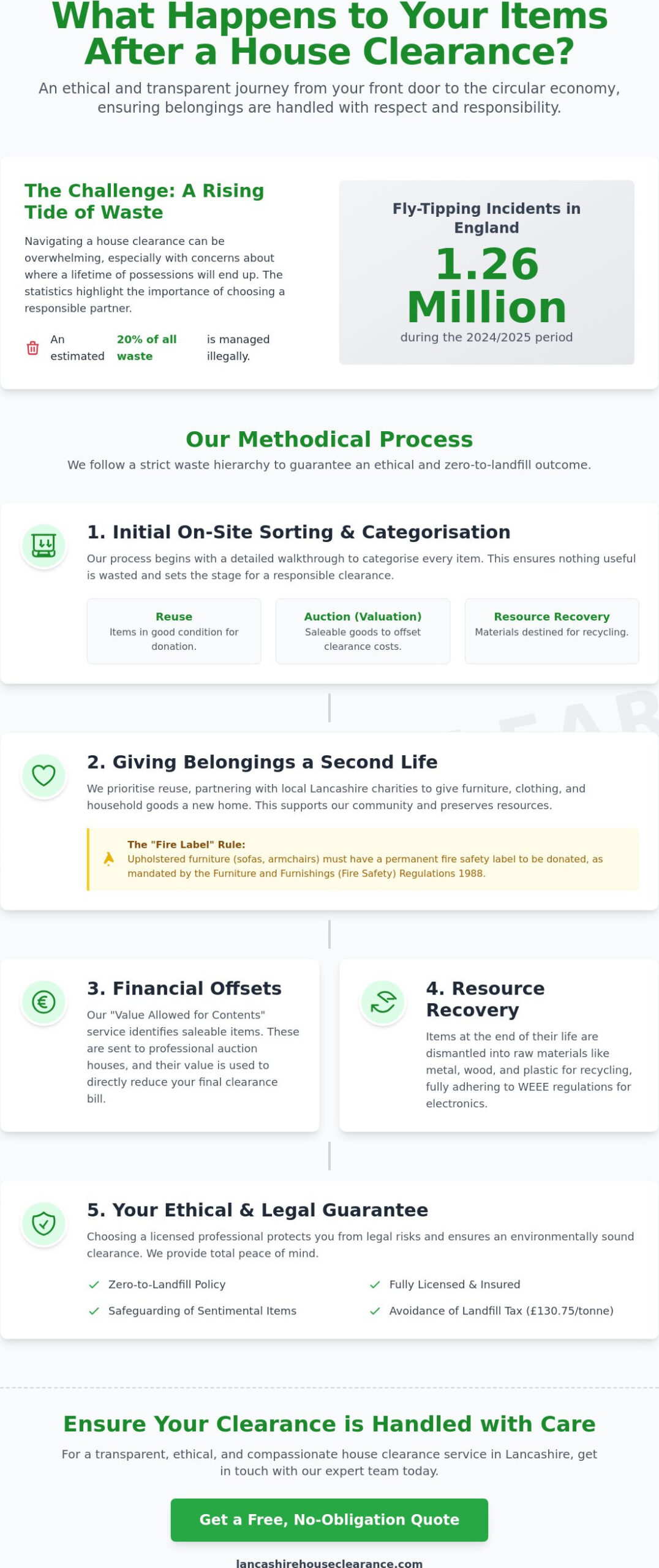
We follow a strict hierarchy of waste management that prioritises the environment and your financial transparency. The first stream is Direct Reuse. Items in good condition, such as sturdy furniture or kitchenware, are set aside for local Lancashire families or community charities. The second is the Valuation Stream. These are saleable goods destined for professional auction houses, where their value is used to offset your service costs. Finally, there is Resource Recovery. For items that have reached the end of their functional life, the Recycling process allows us to dismantle them into raw components like metal, wood, and plastic, ensuring they don’t end up as environmental waste.
Organising the Logistics in Lancashire
Efficiency is a core part of our ethical commitment. We carefully plan our routes through Chorley, Preston, and Wigan to minimise our carbon footprint and reduce transit times. You’ll always see our team arriving in professional, liveried vehicles. This isn’t just for branding; it’s for your security and transparency within the neighbourhood. It ensures that everyone knows a legitimate, licensed professional is handling the estate. Our journey toward a “Zero-to-Landfill” outcome starts with the very first box we pack. By avoiding landfill, we not only protect the Lancashire countryside but also avoid the standard landfill tax rate, which sits at £130.75 per tonne for the 2026/2027 financial year. It’s a smarter, cleaner way to manage what happens to items after house clearance.
Giving Belongings a Second Life: Reuse and Donation
Reuse sits at the very top of the environmental waste hierarchy for a reason. It’s the most effective way to preserve the energy and materials used to create an object. When clients ask us what happens to items after house clearance, they’re often relieved to hear that “clearance” doesn’t mean “disposal.” We actively prioritise finding new homes for functional items. By partnering with local Lancashire community centres and charities, we ensure that usable furniture, kitchenware, and household goods continue their journey rather than ending up in a processing plant. This approach keeps resources within the local economy and supports those who need them most.
Textiles and smaller household items are also vital components of this circular journey. We rely on insights such as Oxfam’s evidence on textile reuse to guide our sorting, ensuring that clothing and linens are diverted to social enterprises where they can be resold or repurposed. Books, toys, and bric-a-brac are frequently donated to charity shops across the region. This methodical sorting ensures that your belongings contribute to the UK’s thriving second-hand market, which is projected to reach £3.5 billion in revenue by 2026.
The “Fire Label” Rule for Furniture
Safety is a legal priority that dictates much of our donation process. We must adhere to strict standards for upholstered items like sofas, armchairs, and mattresses. The Furniture and Furnishings (Fire Safety) Regulations 1988 mandate that all upholstered items must meet specific ignition resistance standards to protect households from fire risks. If a piece of furniture lacks its permanent fire safety label, charities are legally unable to accept it for resale. In these cases, we look for alternative routes. Clean but non-compliant items might be sent to local upcycling projects for professional reupholstering, whilst those beyond repair are stripped down so their frames can be recycled.
When replacing older furniture that no longer meets modern safety standards, homeowners often seek out contemporary alternatives; Living Chic provides a selection of stylish furniture and homeware that can help revitalise a cleared property.
Supporting the Lancashire Community
Our commitment to the region is personal. When we clear a property in Blackpool, Preston, or Blackburn, we make every effort to keep those items within the local community. There is a significant emotional benefit to this process. Knowing that a loved one’s belongings are helping a local family provides a sense of peace that a trip to a skip simply cannot offer. For those managing the loss of a relative, our Bereavement House Clearance Lancashire service offers the empathetic support needed to manage what happens to items after house clearance with dignity. If you’re ready to arrange a responsible collection, you can book a professional assessment with our team today. We’ll help you distinguish between what can be donated and what requires specialist recycling.
Behind the Scenes: Recycling and Specialist Disposal
When an item is too damaged or worn for reuse, it enters a sophisticated industrial recycling stream. This stage is a vital part of what happens to items after house clearance, ensuring that raw materials are reclaimed rather than buried. We don’t simply “tip” waste. Instead, we dismantle complex items into their core components. Metal, wood, paper, and textiles are transported to specialist Lancashire processing plants in areas like Preston and Blackburn. For example, old timber furniture that isn’t fit for a second home is often shredded for biomass fuel or manufactured into new chipboard, keeping resources within the circular economy.
Our team adheres to the strictest environmental standards. We operate with a clear understanding of the waste hierarchy, where recycling serves as the critical safety net for items that cannot be donated. This process is methodical and transparent. It ensures that your residual household waste contributes to the 43.8% recycling rate seen across England, whilst we constantly strive to push our own performance even higher through better sorting and local partnerships.
Managing Electricals and White Goods
Electrical items require some of the most rigorous handling protocols in the industry. We follow the Waste Electrical and Electronic Equipment (WEEE) directives to the letter. This is particularly important given the October 2026 introduction of the mandatory Digital Waste Tracking system, which monitors every movement of electrical waste. Fridges and freezers must be professionally degassed to remove harmful refrigerants before their metal shells are recycled. Televisions and monitors contain hazardous components like lead or phosphorus that require specialist extraction. If you have large appliances, our guide to Bulky Item Collection in Chorley explains how we manage these heavy, complex items safely and legally.
The Zero-to-Landfill Commitment
The ultimate goal for any ethical clearance is to avoid landfill entirely. For residual “black bag” waste that cannot be recycled, we utilise Energy-from-Waste (EfW) facilities. This process involves incinerating non-recyclable materials at extremely high temperatures to generate electricity for the National Grid. In 2024, incineration became the primary treatment route for over 50% of household waste in England, marking a significant shift away from traditional landfilling. By choosing our Zero to Landfill House Clearance service, you’re ensured that what happens to items after house clearance is a journey toward renewable energy. We track every tonne of waste we collect, providing you with the peace of mind that your clearance is supporting a cleaner, more sustainable Lancashire.
Sentimental Discoveries and Financial Offsets
The emotional weight of clearing a home is often tied to the fear of losing something irreplaceable. When families consider what happens to items after house clearance, their primary concern isn’t usually the bulky furniture, but the small, hidden treasures tucked away in drawers or lofts. We understand that we aren’t just clearing a building; we’re often handling the physical history of a family. Our team is trained to look beyond the surface, ensuring that items of high sentimental or financial value are preserved rather than overlooked.
Transparency is the foundation of our service. This extends from how we handle a single photograph to how we manage high-value antiques. We also prioritise data security. Any sensitive documents found during the process, such as old bank statements or medical records, are set aside for your review or securely shredded to prevent identity theft. This methodical approach ensures that your legal and personal interests are protected at every stage of the journey.
The Protocol for Personal Effects
We maintain a strict “found items” protocol. During the clearance, we use a dedicated box for sentimental objects like jewellery, medals, legal deeds, and personal correspondence. These items are safely stored and returned to you at the end of the day. We pride ourselves on a female-led, compassionate approach, which is particularly vital during probate clearances where emotions can be high. Our goal is to provide a steady hand, ensuring that nothing of personal significance is lost amongst the more functional household goods.
How Auction Offsets Work
One of the most significant advantages of a professional service is our “Value Allowed for Contents” system. During our initial assessment, we identify items that have resale potential, such as quality vintage furniture, collectables, or fine art. Instead of these items being a burden, they become a financial asset. We provide a transparent valuation and consign these goods to professional auctions, deducting the expected market value directly from your total clearance fee. If the collective value of the saleable items equals or exceeds the labour and disposal costs, it is entirely possible to achieve a zero-cost clearance. This financial mechanism ensures you receive a fair return on the estate’s assets whilst knowing exactly what happens to items after house clearance. If you would like a transparent valuation of your home’s contents, you can request a professional assessment from our Lancashire team today.
Ensuring Your Clearance is Ethical and Legal
Many homeowners are surprised to learn that their legal responsibility doesn’t end when the van pulls away. Under the UK’s “Duty of Care” legislation, you remain responsible for your waste until it is properly disposed of at a licensed facility. If you hire an unlicensed operator and your belongings are later found fly-tipped, you could face a criminal record and a substantial fine. This is a vital consideration when deciding what happens to items after house clearance. It’s not just about the convenience of the pickup; it’s about the security of the destination.
The most important document in this process is the Waste Transfer Note (WTN). This is a legal receipt that details exactly what was collected, who collected it, and where it is going. You must keep your copy of this document for at least two years. It serves as your proof that you fulfilled your legal obligations. Before booking any service, always verify their Environment Agency Waste Carrier Licence. Under the 2026 reforms, legitimate operators must hold a permit-based licence that includes technical competence tests and background checks, providing an extra layer of protection for the public.
Avoiding the Pitfalls of Rogue Traders
Rogue traders often use “man with a van” advertisements to lure clients with prices that seem too good to be true. These operators frequently lack the necessary insurance and licensing to handle household waste. The risk is particularly high in areas like Wigan and Blackpool, where councils deal with thousands of fly-tipping incidents every year. If a quote is significantly lower than others, or if the contractor insists on cash only and refuses to provide a WTN, these are major red flags. Choosing an established professional ensures your items don’t contribute to the 20% of waste that the Environment Agency estimates is managed illegally. For more localised advice on responsible disposal, see our resource on Rubbish Removal in Wigan.
Why a Family-Run Lancashire Firm Matters
Accountability is easier to find in a local, family-run business. Lancashire House Clearance is a female-led firm with 30 years of experience serving the Lancashire community. Our heritage means we aren’t just a service provider; we are your neighbours. We have a deep commitment to the Lancashire environment, ensuring that what happens to items after house clearance aligns with our principled standards for reuse and recycling. We handle every estate with the same care we would give our own families, combining professional authority with genuine empathy. If you need a service that values personal integrity as much as operational success, you can request a compassionate, ethical quote today. We’ll provide the transparent guidance you need to navigate this transition with total peace of mind.
Clear Your Property with Confidence and Care
Understanding the journey of your possessions changes the experience of a house clearance. It moves from being an overwhelming chore to a structured, ethical operation. By prioritising reuse and adhering to strict recycling standards, we ensure your items benefit the local Lancashire community and the environment. When you know exactly what happens to items after house clearance, the process feels less like a loss and more like a responsible transition for your home and its contents.
You don’t have to manage this transition alone. Our team provides the legal security of being a fully licensed Waste Carrier and the financial transparency of our Value Allowed for Contents service, which uses auction offsets to reduce your bill. With a firm zero-to-landfill policy, we guarantee that every item is handled with the highest level of integrity and professional care. We’re ready to provide the practical support and empathetic guidance you need to move forward.
Get a Compassionate Quote for Your Lancashire House Clearance
Frequently Asked Questions
Do I need to sort items into boxes before the clearance team arrives?
No, you don’t need to box or sort anything yourself. Our team carries out a methodical walkthrough to categorise items for reuse, auction, or recycling as part of the service. We prefer to see items in situ to ensure we don’t miss any sentimental objects or high-value collectables. This approach reduces your stress and allows our experts to organise the logistics efficiently from the moment we arrive.
Can you take items that charities have refused, such as sofas without fire labels?
Yes, we can clear furniture that charities have rejected, including upholstered items without permanent fire safety labels. Whilst these items cannot be donated for reuse under the 1988 Furniture and Furnishings Regulations, we ensure they are processed through the correct recycling stream. We dismantle these pieces to reclaim raw materials like wood and metal, preventing them from becoming environmental waste or ending up in landfill.
What happens to personal documents and old bank statements found in the house?
Any personal documents, bank statements, or legal deeds we find are immediately set aside in a secure “found items” box. We understand that identity theft is a significant concern, so we offer to return these sensitive items to the family or arrange for professional shredding. This protocol is a standard part of our compassionate approach to managing what happens to items after house clearance.
How do you determine the value of items that go to auction?
We determine auction value through a professional assessment of the item’s condition, age, and current market demand. Our team has decades of experience identifying antiques, mid-century furniture, and niche collectables that will perform well at consignment. This valuation is transparently documented and used to provide a “Value Allowed for Contents” offset, which is then deducted from your final invoice to reduce the overall cost.
Is it possible for a house clearance to be free if the items are valuable?
It is entirely possible for a clearance to be “cost-neutral” if the saleable assets within the property are valuable enough. If the professional auction valuation of the contents equals or exceeds the total cost of labour and disposal, we can offset the bill entirely. We discuss these potential financial offsets during the initial property walkthrough to ensure total transparency and fairness for the estate’s executors.
What happens to electrical items like old fridges and cookers?
All electrical goods are managed under strict Waste Electrical and Electronic Equipment (WEEE) regulations. We use the 2026 Digital Waste Tracking system to ensure every appliance is accounted for during transit. Fridges are degassed before recycling, and hazardous components in televisions are extracted safely. This ensures that what happens to items after house clearance remains environmentally responsible and fully compliant with current UK environmental law.
Will I receive proof that my items were disposed of legally?
Yes, you will receive a Waste Transfer Note (WTN) for every clearance we complete. This document is your legal proof that your “Duty of Care” was met and that your waste was transferred to a fully licensed carrier. Under the 2026 permit-based licensing reforms, this documentation is more critical than ever. You should keep this receipt for at least two years to protect yourself against potential fines.
Do you clear everything, including rubbish in the garden or loft?
We provide a comprehensive service that includes clearing all areas of the property, such as lofts, cellars, gardens, and outbuildings. Whether it’s old garden furniture, loft insulation, or bulky items in a garage, we handle the heavy lifting and sorting. Our aim is to leave the entire site clear and ready for its next purpose, regardless of where the items are located or how difficult they are to access.
Ready for a free, no-obligation quote?
Call or message us today — tell us the postcode and what needs clearing, and we’ll do the rest.